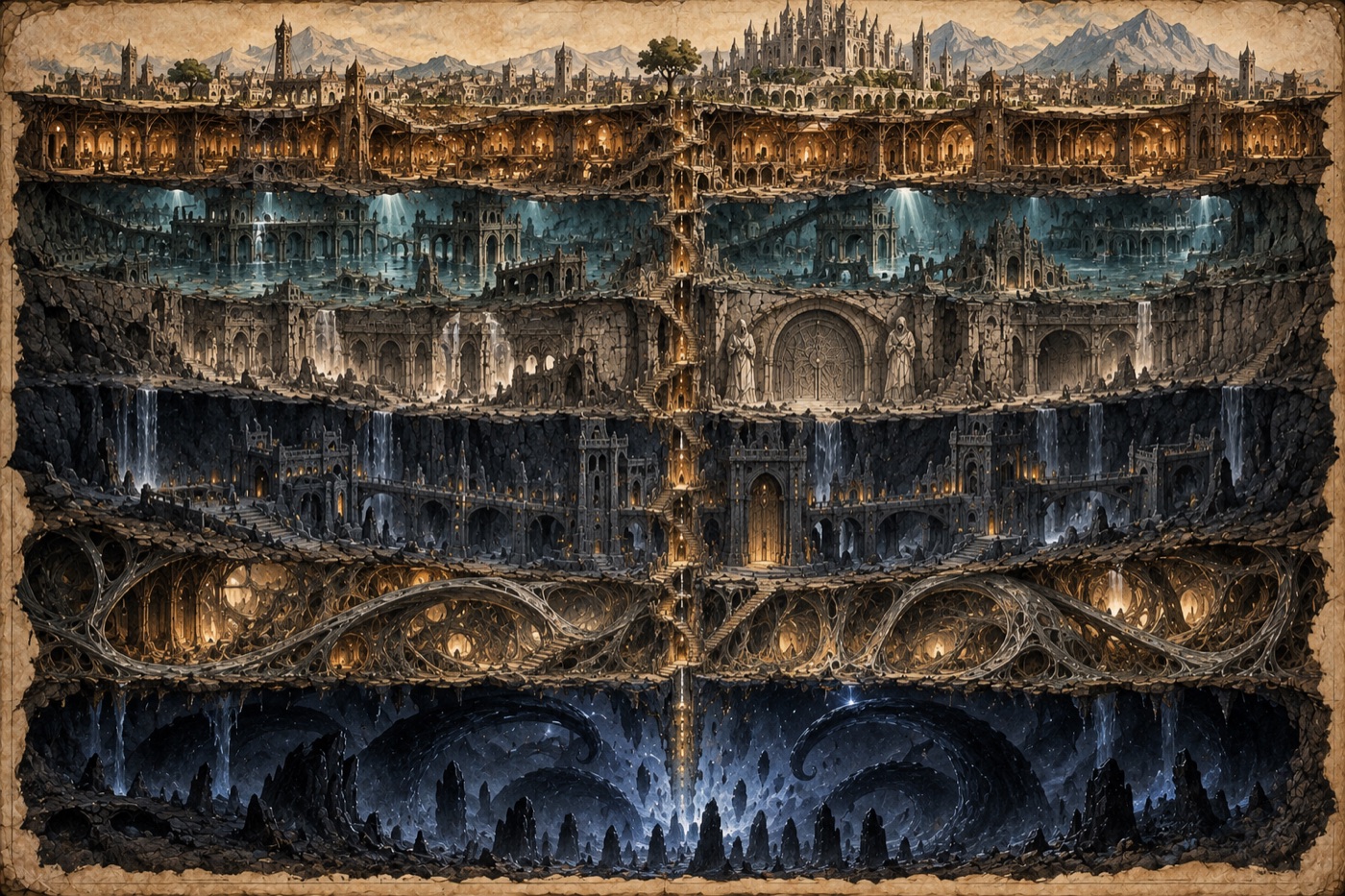
The Sediments,
the descent beneath Sylkaen
Beneath Sylkaen there is no bedrock. There are worlds. Every civilization that rose reshaped the continents before collapsing in a Rupture, and each one left its layer. The world of today is only the thinnest, and the most recent, of them all.
One tier per part, its map, its game property, its places, its figures and its dangers. 5e and 3.5 editions included.
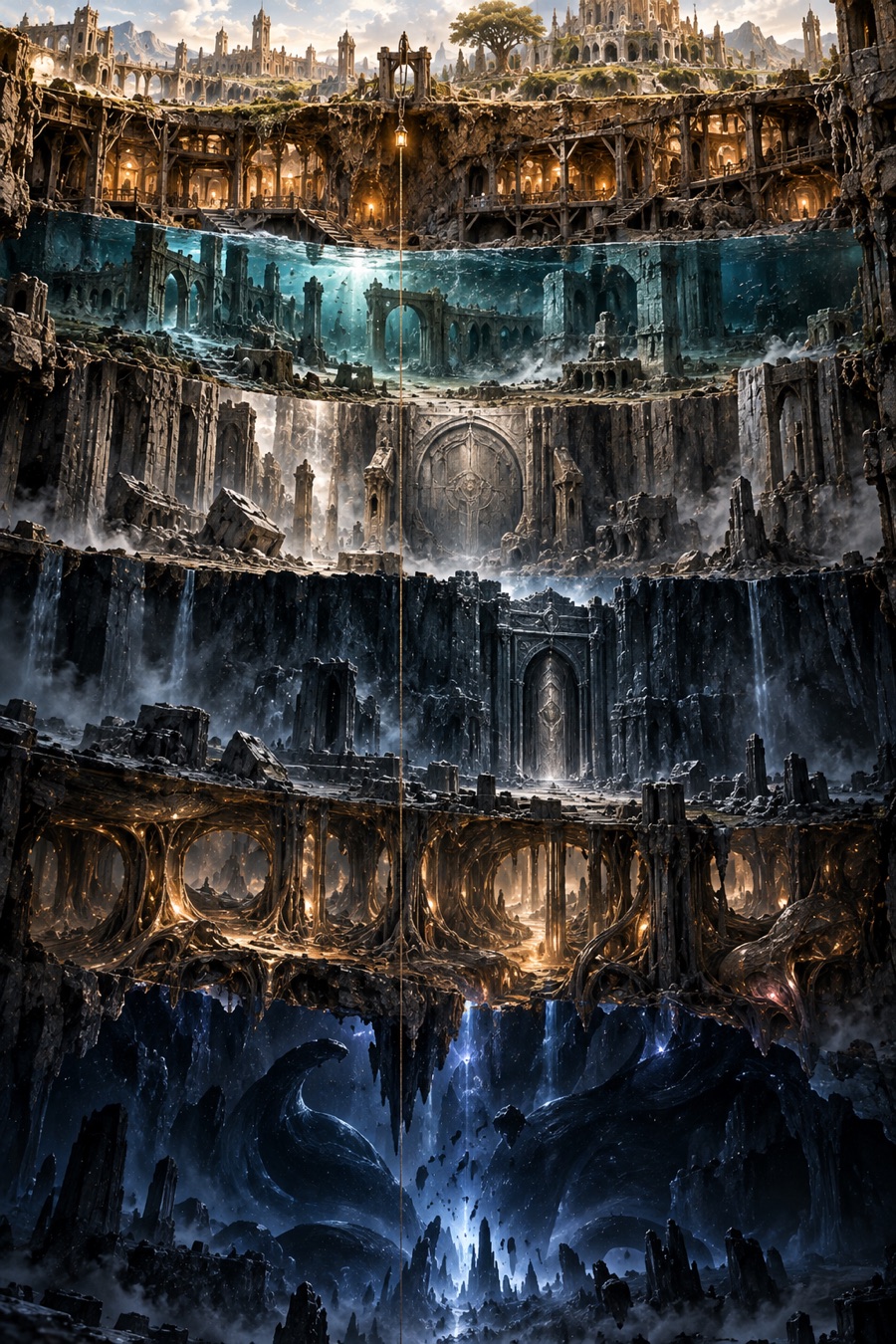
You don't dig a hole, in Sylkaen. You pierce worlds.
Going down
is going back in time
Each tier belongs to an age older than the one above it, and the older the age, the less it obeys today's rules. Where History tells this stacking in time, this book describes it in space.
A dig, not a dungeon
The introduction lays out the method: how a descent is prepared, what you bring, what changes at every tier you cross, and when to turn back. The Sediments, the Vestiges found there and the Strata brushed against on the way are told apart once and for all, so the table always knows what it is stepping into.
Each tier has its property
The Living Crust is charted. The Foundations retain what happened there. The Bed of Ruins still answers. The Bedrock weighs wrong and keeps its orders. The Deaf Layers contaminate what they touch. The Bottomless refuses measure. Six properties that concretely change what the characters can do.
Six tiers,
one descent
After the introduction, each tier gets its part: its landmarks, its map, who lives there and who goes down, its property, its dangers, then its places and its characters.
The Living Crust
Nobody down there calls it a layer. They call it home: cellars, working mines, foundations that are kept up, from the New Well Concession to the Tavern of the Last Tier.
The Foundations
The layer people dig. This is where the archaeologist's trade begins, when what you find is recent enough to be dated and old enough to sell dear. The Swallowed City, the Crypt of the Shoreless Voices, the Drowned Market of the Three Bells.
The Bed of Ruins
The last place where things still look like what they are. A door remains a door, even when no one knows how to open it anymore: the Anvil That Still Strikes, the Door That Doubts, the Metronome of the Rifts.
The Bedrock
The last step where a step can still be recognized. Above, you dig. Below, you pray. The Scale That Never Tips, the Wall That Bears Two Names, the Lock of the Too-Deep.
The Deaf Layers
Where stone stops keeping its promises, and the first tier where understanding truly ends. The Grove That Breathes, the Wall That Rewrites, the Nest That Ages Backward.
The Bottomless
A name given to what people refuse, precisely, to name. Nobody knows who, if anyone, lives there. The book stops at the edge, with those who keep watch over it, and leaves you to decide what lies beneath.
Scholars count eight Cycles where the sounders count six tiers. The two counts do not contradict each other: a Cycle lasted, a tier has a thickness.
What you find
in a tier's part
Take the Foundations. The five other tiers are built the same way, so you never have to relearn where to look.
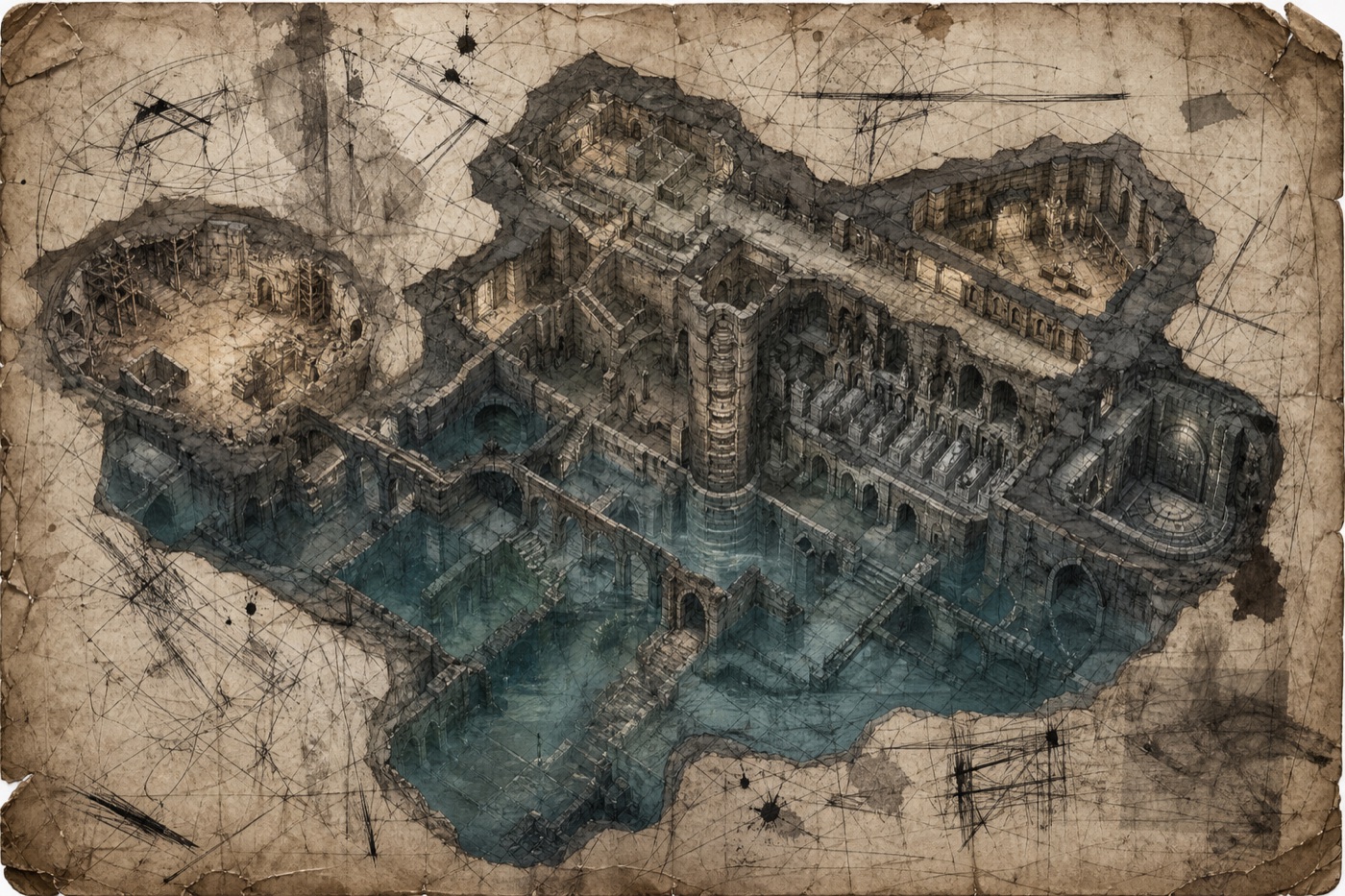
The landmarks, then the map
What is found there, who goes down, the timeline of the Cycles that settled into this layer, and a map of the tier. Then the game property: in the Foundations, Remanence, what happened there and has not finished happening.
Twenty-eight places
From the Yard of the Three Soundings to the Submerged Gardens of Bitter-Salt. Every entry follows the same cut: what you see, the figures to talk to, the adventure hooks, then the dangers and mysteries the GM keeps to themselves.
The tier's characters
Four in the Foundations, from Grand Archivist Solenne Keeps-Memory to Voss Three-Fingers: people, class, level, what they want, what they hide, and their stat block in both editions.
At the GM's table
How to run the tier: the pace of a descent, what the property changes in ordinary scenes, and the dangers specific to the layer. The Foundations part closes on the Workshop beneath Nyméria, run as a dig rather than a dungeon.
Twenty-one people
who know what sleeps below
Three to five per tier, all the way to the edge of the Bottomless. Each has a full entry, secret included.

An entry, not a line
People, class, level, place, affiliation, then what the figure wants, what they hide, how to play them, a hook, and their stat block in case the conversation goes wrong.
Grand Archivist Solenne Keeps-Memory
Mnesic, level 12 cleric of the Oracle of Cycles, head of the Archivists of the Second Voice in the Foundations for twenty-eight years. She has gathered more silent vigils than any other member of the order. “I have listened to more griefs than any living Mnesic. Some mornings I no longer know which ones were mine.”
What they hide is written down
Her own memory frays a little more each year. Every morning her steward reminds her, aloud, of the decisions taken the day before. She refuses any object that could amplify what she already hears: a principle, not a precaution.
They know each other
Maren Long-Case, the next entry in the book, was trained by her. What Maren goes down to find, and what Solenne would rather she never brought back up, can be read across the two entries.
Frequently asked questions about The Sediments
What is in The Sediments?
It is Sylkaen's vertical supplement, 189 pages in seven parts: an introduction that lays down the rule of the deep and the procedure of a descent, then one tier per part, from the Living Crust to the Bottomless. Each tier has its landmarks, its map, its game property, its dangers, its places written as ready-to-run entries and its figures with their stat block. In all, 115 places and 21 characters. Both rules editions are included in the same purchase.
Do I need the other books to use it?
No. It describes what lies beneath the world; it does not replay the rules. It reads and runs on its own, even under a campaign that has nothing to do with Sylkaen: a six-storey underground fits beneath any city. The Complete Bundle remains necessary to play Vestiges itself, with its peoples, classes and setting.
How does it differ from The Crown-World?
Both describe the same world along two axes. The Crown-World travels the surface: the six regions, their cities, their roads, what the kingdoms fight over. The Sediments goes down: six tiers, from the soil people plough to the Bottomless, where each level belongs to an age older than the one above it. One reads in breadth, the other in depth.
What is the link with the Nyméria supplement?
Nyméria describes the starting city and the Workshop stacked beneath its streets, one dead Nyméria per Cycle. The Sediments places that Workshop in the general descent: the Service Levels in the Living Crust, the Drowned Nyméria in the Foundations, the Nyméria of Chants and of Doors in the Bed of Ruins. The two complete each other; neither is required for the other.
How many tiers and places does it contain?
Six tiers, each with its part and its map: the Living Crust (26 places), the Foundations (28), the Bed of Ruins (23), the Bedrock (18), the Deaf Layers (20), and the Bottomless, described from its edge. That is 115 places and 21 characters, plus a master map that stacks the six tiers.
Where do I get it, and at what price?
On the official itch.io store, pay what you want from €8, like the rest of the line: a high-definition PDF, immediate download, future updates included. Every title is bought independently.